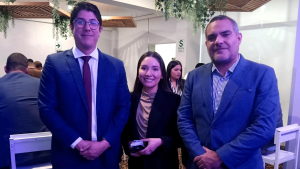
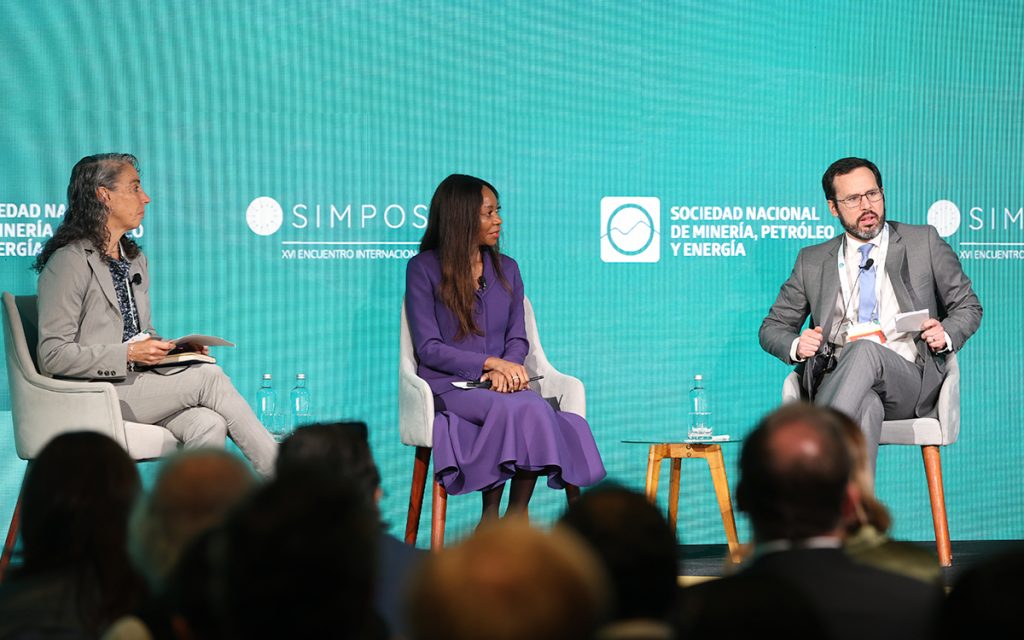
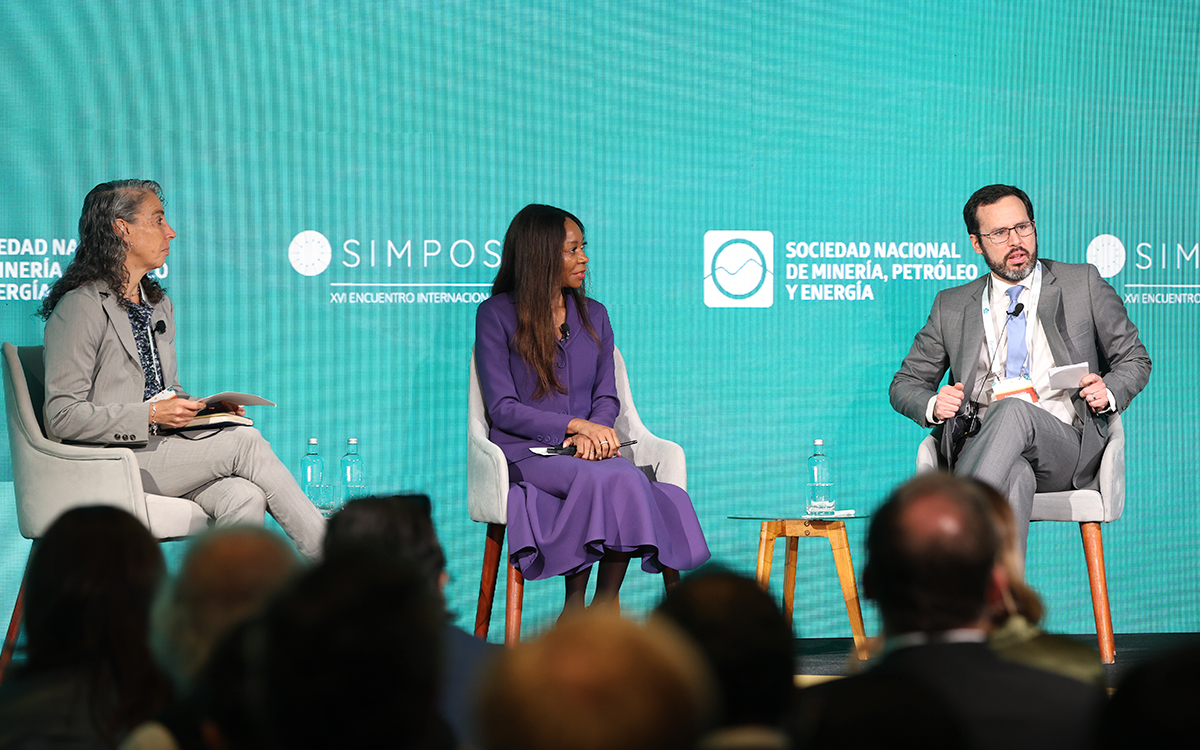
In a context marked by geopolitical fragmentation, capital scarcity, and the energy transition, the international economist Dambisa Moyo pointed out — in dialogue with Peruvian economists Carolina Trivelli, a member of the Fiscal Council of the Ministry of Economy and Finance, and Diego Macera, director of the Peruvian Institute of Economics (IPE) — that Peru needs to build a long-term strategy that allows for the transformation of the current favorable cycle of minerals, the so-called Boom, in sustainable development, in being more competitive, and in achieving greater social stability.
During the panel “Conversing with the Keynote Speaker,” held as part of the SYMPOSIUM – XVI International Mining Meeting, Moyo maintained that the country must think about strengthening its domestic market and project a broader and more inclusive vision of growth.
Leadership from Peru
The economist pointed out that in a more competitive international scenario, it's not enough to rely on natural resources or short-term economic growth. “In a world where capital is scarce, the story we tell (to attract investments), the vision of what you want to do, has to be much more compelling,” she stated.
The specialist in macroeconomics and globalization stated that Peru should take advantage of the opportunity to exercise greater regional leadership and attract more investment, although she emphasized that the volatility of public policies can negatively affect investor perception.
Likewise, he indicated that for the country to grow, it must avoid depending exclusively on the current mineral supercycle and move towards structural transformations. Along those lines, he recalled that China's growth and global demand for commodities they are not permanent, so he raised the need to define what Peru's “manifesto” will be for the next five or ten years, that is, how the resources generated by mining will be used for progress.
For his part, Diego Macera suggested that developing countries should analyze the experiences of economies that have managed to design long-term development strategies, effectively managing their natural resources to drive economic growth. He also pointed out that, in the case of small or emerging economies like Peru, a lack of political and institutional continuity in key areas can weaken the capacity to implement sustained economic policies.
“The big question for mineral- and hydrocarbon-based economies is how to do better,” Moyo noted, after commenting that several countries continue to face structural problems of inequality, basic infrastructure, and social gaps, despite registering high incomes from their natural resources.
The economist also remarked that the private sector, especially the mining sector, can play a broader role in the country's economic and territorial development. She explained that the sector's impact can be expanded to boost supplier chains, services, universities, and other linked productive activities.
Global and local context
On the other hand, Trivelli recalled that the country is in the context of elections for its authorities, with high public sensitivity, that inflation will be a relevant topic throughout the year, and that, at the same time, it will face pressures associated with the escalating international oil prices.
However, he pointed out that this scenario coexists with a favorable context of high revenues derived from the mineral supercycle, which will mean the arrival of greater resources for the next government. In this regard, he warned that the challenge will be to adequately manage this combination of opportunities and risks.
Finally, Dambisa Moyo argued that inequality and the lack of inclusive growth represent risks to the stability and continuity of economic growth. Therefore, she considered that mining has the opportunity to promote education, territorial development, and the closing of social gaps. “We have to ask ourselves what growth really means and what the strategy for distributing the resources generated by that growth is,” she stated.
The SYMPOSIUM – XVI International Mining Meeting, organized by SNMPE, will be held from May 26 to 28 at the JW Marriott Hotel Lima, under the motto “Mining that integrates, builds the present, transforms the future.”.