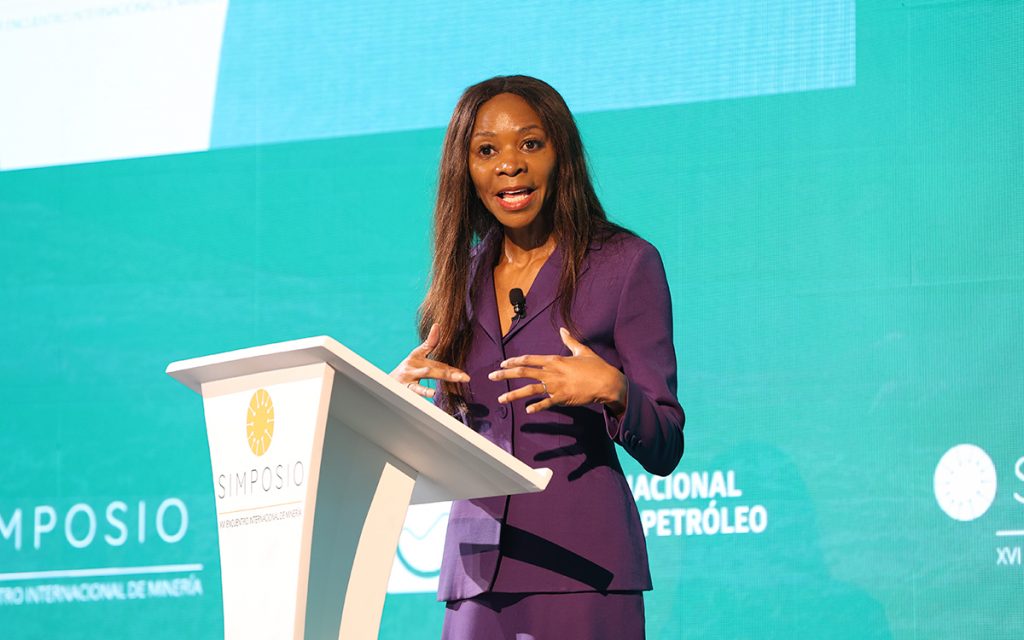
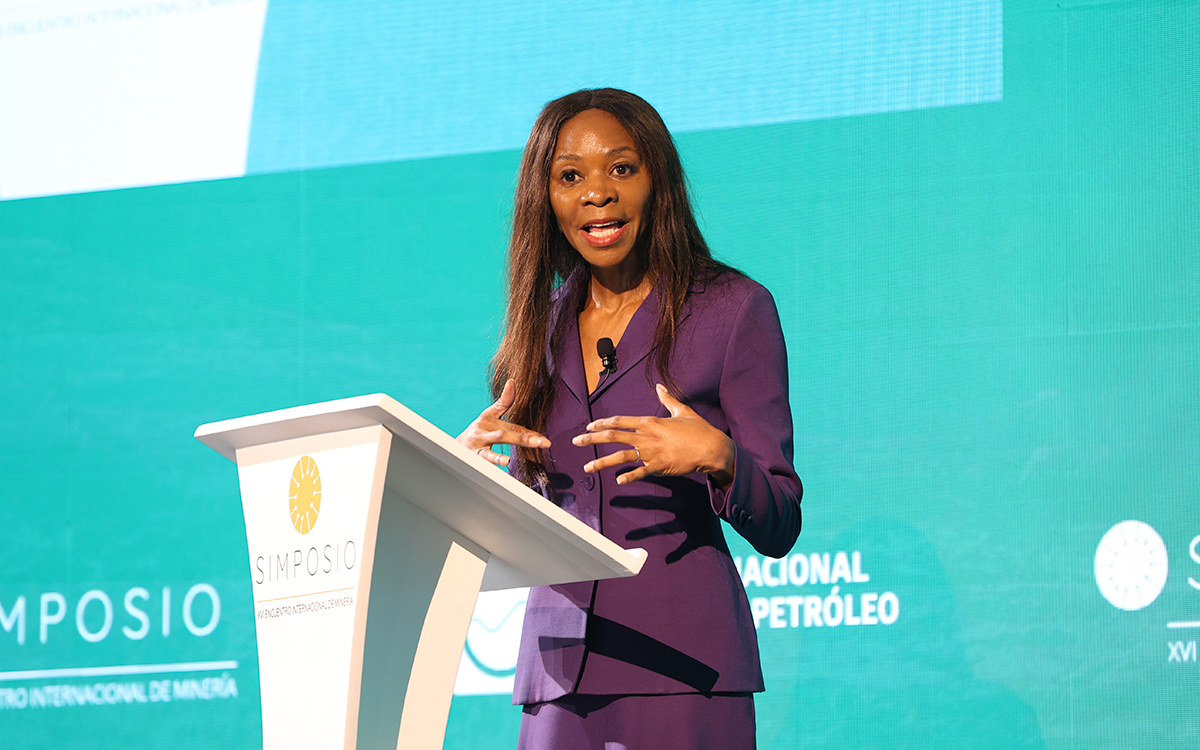
African economist Dambisa Moyo, a member of the British House of Lords and one of the world's most influential voices in macroeconomics and globalization, stated that Peru has the opportunity to “change its history” and turn its mineral wealth into a platform for sustainable progress, in a global context moving towards deglobalization, artificial intelligence, the energy transition, and increasing competition for capital.
During his presentation at the SYMPOSIUM – XVI International Mining Meeting, organized by the National Society of Mining, Petroleum, and Energy (SNMPE), Moyo analyzed the main challenges of the global economy and geopolitics, with special emphasis on the role that countries producing critical minerals, such as Peru, can play.
The expert noted that the world has entered a period of slower economic growth following the 2008 financial crisis and the 2020 pandemic. In that context, she explained that double-digit growth rates—or levels close to 6%—which emerging economies like Peru’s achieved in previous decades will no longer be easily observed.
“For a country to double its per capita income within a generation, it needs to grow at a sustained rate of at least 3.1% annually, and Peru has been maintaining growth around this threshold,” he said. He added, however, that this goal will become increasingly challenging in an international environment marked by higher inflation, geopolitical tensions, and reduced global momentum.
Moyo maintained that, despite this challenging scenario, there are two major supercycles that will shape global investments in the coming years: artificial intelligence (AI) and the energy transition. Regarding the first, he indicated that AI has the potential to transform global productivity, reduce costs, and generate new economic opportunities. Regarding the second, he pointed out that electrification and sustainability will maintain a relevant window for critical mineral producing countries.
However, he warned that these supercycles also pose risks. In the case of artificial intelligence, he mentioned its potential effects on the labor market, especially the disappearance of jobs linked to routine tasks. He also alerted about structural trends such as the demographic crisis, the decline in educational quality, inequality, and increased migration, factors that have been fueling greater political and social instability globally.
Regarding copper specifically, Moyo maintained that current high prices represent an opportunity for Peru, but should not lead to complacency. “Peru cannot be complacent relying solely on copper nor assume that demand will last forever. It needs to change its story, strengthen its legal stability, improve its education and infrastructure, and build its own narrative capable of convincing investors to take risks,” he stated.
Likewise, Moyo stated that the current context demands looking at the lessons of the past. “History repeats itself,” he asserted, comparing the shocks of the 1914-1929 period—world war, pandemic, and economic depression—with recent events: the global financial crisis, the pandemic, and current war tensions. As he explained, the world could face decades of international economic friction, in a context of deglobalization and more intense competition for capital.
In that scenario, he argued that attracting investment will be increasingly difficult, as capital is becoming more regional, more cautious, and more nationalistic. Therefore, he stated that Peru must differentiate itself from other countries competing for the same financial resources, even though working in a regional bloc for this purpose will be difficult. .
Finally, Moyo remarked that Peru's challenge is not just to sell copper, but to transform its mining potential into development, competitiveness, and resilience in a more fragmented world. To achieve this, he indicated, the country must act with long-term vision, strategic humility, and the ability to adapt to technological, economic, and geopolitical changes.